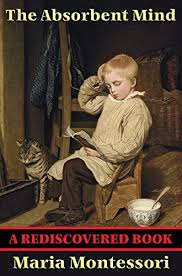
When I was starting out homeschooling, I read a book by Maria Montessori called “The Absorbent Mind.” It was transformative to me as a parent and teacher. I highly recommend it to everyone who works with children.
Maria Montessori was one of the first female physicians in Italy. Born in 1870, she began her career working with children with disabilities who were kept in the asylums of Rome. Her first book, “The Absorbent Mind,” talks about her early work and studies.
1. Don’t do anything a child can do for themselves – the hand over hand method
This may seem contradictory to you. The hand-over-hand method is when you genitally take a child’s hands and guide them through an activity. With my son, I put a pencil in his hand and slowly traced letters. How is this having a child do something themselves? You do not force a child to do this against their will. For children who will not reach out and try to do something that is demonstrated to them, this is the next step in teaching them independence.
The hand-over-hand method creates muscle memory and neuro-pathways for how to do something. Parents sometimes use this method when teaching young children how to wash their hands or brush their teeth. You can use this method to teach writing, typing, cutting, and many other skills as well. Eventually, as a child learns the skill, you move your hand to guiding their wrist rather than hand-over-hand. Then you may had then try the task one time alone before doing the others hand over hand.
The brilliance of this method was shown to me when I observed a special needs classroom in which the teachers were busily cutting and pasting an activity for these severely disabled children. The children just sat and watch them. These children were not learning how to cut and paste. They were learning helplessness. It would have been better for the teachers to take the child’s hands and help them do the activity themselves. Unfortunately, in a classroom, there is often no time for that, but in homeschooling, you can make the time.
Using this method, my son learned how to write both print and cursive on his own, He has also become a fan of drawing.
2. Don’t talk so much!
Montessori asked some student teacher to teach the class what a square was. She handed them a red, wooded square to use as a prop.
The student teacher help up the red square and said “Look class! This is a square. It has four straight sides. One, two, three, four. Four corners: one, two, three, four. It is not a circle…” and on the teacher talked. The children began to fidget and wander off.
Then Montessori took the red square and a red circle and asked the most fidgeting child which one was the square. the child couldn’t say.
Montessori took the red square and to a red circle and went to another one of the children. She handed the red square to him. “This is a square. Say square.”
The child held the square and played with it and said “square.”
The Montessori took the square back and handed the child the circle. “This is a circle. Say circle.”
The child played with the circle and said “circle.”
Finally, Montessori asked the child which one was the square. The child knew the correct answer.
For the special needs child, much of our curriculum is fluff. Cut a way the fluff and focus on the one thing you are trying to teach. If a child learns one thing during each lesson, then you have accomplished something ad often that is enough. Take education one step at a time.
3. Children learn through their senses
Montessori observed that children learn by touching, tasting, looking, and hearing things. We all learn this way. Many of us have learned about visual learners, auditory learners, and kinesthetic learners who learn mostly through one of the senses. Well, researchers have discovered that even if that is true, the most senses we use the better we learn something. The majority of Montessori’s method revolved around “toys” that were child-sized. She was not a fan of worksheets. She believed that children learned best during play. This is their work.
This was a difficult concept for me to use. Both my sons have hated crafts and coloring. My oldest was also so distracted by manipulative that learning stopped whenever I brought them out. What I learned was that songs with movements worked well. Having him do real chores (hand-over-hand at first) was great for him. We did science experiments, YouTube videos, games on the tablet, typing, play-doh, field-trips (during quieter hours), flash cards, and felt-boards. We did cut and paste matching activities, timeline pages in a notebook. I researched ideas on Teachers Pay Teachers for any way to teach the topics in our curriculum that required less talking and more sensory in-put. It took a lot of prep work, but it made learning soooo much easier.
4. Observe your child and record data
Montessori was a physician first and an educator second. She approached teaching like a scientist. She observed what a child was doing and recorded their developmental progress. This is the same method used by many kinds of therapies today. Parents of children with autism may be familiar with ABA therapy’s method of trials and data collection. Speech therapies and Occupational therapist do this as well. I highly suggest trying to do this yourself.
I did did this by downloading a massive developmental list from some websites and checking off what my son had learned as he grew. This wasn’t to grade him or to compare him to other children. I used this to know what we needed to work on next. One list I found focused on social skills. Another list was the Texas Teks that is used by public school to design curriculum. Another list I found was for speech development. All of these were free. I would look at these lists every month or so and check off some things and date it. Then I would find a few things to make our next goals and work on those.
5. Relationship is primary!
Out of all I learned from Maria Montessori, the most important was the relationship part of her teaching. She really cared about the children she taught. She played with them and showed them new ideas with motivation and exuberance.
Homeschooling is hard, but it should be relational and fun too. If this isn’t the case, than something needs to change. Children learn best when they are interested in what they are doing. They are more interested in it if you are too.
I love history. I have finally discover a way to get my anti-social son to love it too. He loves lists and memorizing lists. This year we are memorizing all the US presidents, and we love it together! I get to share the stories in American history while he gets to line up Velcro cards of the presidents faces on the felt board. It was hard for me to come up with something that he would like, but now we talk about the presidents all the time.
I hope this helped you as much as they helped me!
Check out my young adult fantasy fiction novels HERE for something optimistic and fun.
If you like this article, consider subscribing to my quarterly newsletter.

What do you think?