

“I mean by a picture a beautiful romantic dream of something that never was, never will be—in light better than any light that ever shone—in a land no one can define or remember, only desire…” The Pre-Raphaelite painter, Sir Edward Burne-Jones, said this to explain his style to those around him. Through his unique style, he became internationally famous in his own lifetime, yet now in America, he is unheard of. He was a dreamer in a different way than any major artist before him. He used literary themes and fairy tales as symbols for the way he felt about life. I am drawn to him as my favorite artist because he accomplished through art what I dream of accomplishing through writing. He created a dream that was contagious all over the British Empire. Even Salvador Dalí in Spain was influenced by it.
All of this is not enough for us to even know his name in the common culture of the US. We prize our industrial, modern world so much that dreams must involve money or something solid to be considered worth our time. Fairy tales are for children; we want rags-to-riches stories. Burne-Jones had a dream that would not be considered important enough today. This dream was a study of love, beauty, goodness, and virtue. He wanted to leave the world a better place than he found it. He discovered an outlet for his dreams in the established Pre-Raphaelite movement.
The Pre-Raphaelite movement was full of dreams and romance, but each member of the movement portrayed this in different ways. During Victorian times, the movement developed a style of painting that separated itself from the Academy. The goal of the Pre-Raphaelite movement was to return to nature and find the beauty in it. They wanted to start a movement that involved all the arts except music and drama. As idealists, they began to move past being true to nature and started to explore truth in the beauty of art. They illustrated literature or wrote poems for their illustrations. Burne-Jones was one of the later artists of the movement who took these ideals and developed them further throughout his career.

Two good examples of this development are The Mirror of Venus (fig. 1) and The Golden Stairs (Fig. 2). These two pieces were not based on any particular subject or story, but seem like something from some far-off place. They were both original ideas that came from Burne-Jones’s imagination. They are an illustration of an idea, feeling, and dream in one. The Mirror of Venus (fig. 1) is a melancholy piece that evokes some introspective thought. The nostalgia that is portrayed seems to be looking to the past for better days. Venus and her maidens seem to be looking in the pond, yet beyond it at the same time. The rocky arid landscape that is seen in the background of this work is commonly copied by all of Burne-Jones’s followers. This was one of the pieces in an exhibit at the Grosvenor Gallery in 1877 that made him famous overnight.
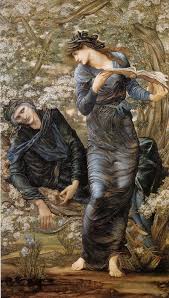
Another art piece that was exhibited in the Grosvenor Gallery in 1877 was The Beguilement of Merlin (fig. 3). This piece is an illustration of the French medieval book “Romance of Merlin.” It is about an enchantress lulling Merlin to sleep in a hawthorn bush in the forest of Broceliande. The folds of the garments show the Italian classical influence from Burne-Jones’ trips to Italy. In every piece, he is consistent in his portrayal of the medieval world.
He dreamed of the perfect world that he created throughout all his works. He wanted to make this imaginary place as real as possible. The goal of having a dream turned into reality is not a common theme throughout art. Most movements try to base their goals on something more solid, like their perceptions of physical things, events, or academics. In the Pre-Raphaelite movement, non-reality came first as something that all people wish for but do not think possible. Burne-Jones made this ideal a reality in his own little world by creating many types of art, including furniture and tapestries. He is most famous for his amazing paintings that seem not of this world, for which he never had formal training to create.
Even Burne-Jones’ home was a handmade replica of his imaginary medieval world. He chose to ignore the outside world and all industrial progress. He lived in an ideal world where everyone cared for their fellow man. “Existence had become a cloister in which he shut himself up without thought of what was outside it until the very idea of clash and conflict and imperfection was dreadful to him.”
Sir Edward Burne-Jones was attending Oxford to become a priest when Morris, a friend of his, introduced him to Sir Thomas Malory’s “Morte d’Arthur.” This book sparked his creative nature and made him decide to dedicate his life to art. It changed his life and always stayed in his imagination. He would say that he had never heard anything more beautiful in his life. At the end of his career, his last painting would be The Last Sleep of Arthur in Avalon (fig. 4), which was left unfinished. He considered this to be his most important work. He had fallen in love with the ideals that the book described about the Knights of the Round Table. The Pre-Raphaelite movement was a brotherhood that seemed to embody this.

Another influence in Burne-Jones’ life was the Catholic writer, John Henry Newman. Newman taught him to ignore the comforts of this material world and to focus on the things unseen. Burne-Jones never lost his spiritual fervor. He even said about the story of Christ, “it is too beautiful not to be true.” Most of his works are based on stories of people who are willing to give up everything for an intangible thought or principle. This was also something that Burne-Jones would find in common with the Pre-Raphaelite movement, even if the principles were not specifically Christian.

Burne-Jones became an artist in the Pre-Raphaelite movement without any experience. He learned to paint through observing other artists in the movement and going to Italy to study the art there. In his first year of painting with watercolor, he painted Sidonia von Bork (fig. 5). This painting shows the influence Rossetti, the founder of the Pre-Raphaelite movement, had on Burne-Jones’s developing art style. Rossetti composed his pieces in primary colors, while Burne-Jones composed his pieces in secondary colors. In this early piece, Burne-Jones was still painting in primary colors, but after his trips to Italy, he developed his own sense of color relationships. This piece also shows that Burne-Jones had already started to paint literary themes and had begun his love affair with beauty.
Burne-Jones painted stories and myths that he read as symbols to inspire the world. He said, “Only this is true, that beauty is very beautiful, and softens, and comforts, and inspires, and rouses, and lifts up, and never fails.” He created an imaginary world of knights, chivalry, and ladies in distress. When he was in love, he would paint themes about love. When he was depressed, he would paint themes about the femme fatale. He would bring the symbolism of literary themes to life.

The idea of a love so strong that a person would give up his worldly possessions inspired Burne-Jones to illustrate an Elizabethan ballad about that same theme. This painting is King Cophetua and the Beggar Maid (fig. 6). In this work, Burne-Jones depicts the beggar maid as the focal point of the piece. She almost glows with an angelic beauty. King Cophetua stares at her with his crown in his hands as a symbol of his giving up his riches for her. This piece, which was exhibited at the Grosvenor Gallery in 1884, is one of Burne-Jones’ most famous works. It was also highly praised at the Exposition Universelle in Paris in 1889. It is one of the best examples of Burne-Jones’ passion for his dream-like medieval land.
The outside world was very different from his dream world. The Revolution broke out in France. Civil War raged in Hungary, Austria, Poland, and Italy. Karl Marx published the Communist Manifesto. After England’s Industrial Revolution, factory workers complained about not having enough food. The world was in upheaval when the Pre-Raphaelite movement started. Each person in the movement tried to ignore the outside world and protest against it in their own unique way. Burne-Jones tried to create a small world of beauty in his home as an example of what the world should be. The aesthetics that he created seemed above all darkness in the world.
“The aestheticism of… Burne-Jones is not a creed of ‘Art for Art’s sake’; rather it is a spirited reassertion of those principles of color, beauty, love, and cleanness that the drab, agitated, discouraging world of mid-nineteenth century needed so much. It is more accurately defined as an escape from them, a protest none the less sincere for the preference of some of its exponents for a world of aesthetic imagination.” Even when artists in France were beginning to paint Impressionism, he continued with the same goals he had begun with. He was always motivated to push himself to try new projects in that pursuit.

His Perseus series was the biggest and most ambitious cycle of pictures he created. The Baleful Head (fig. 7) is one of the four that he fully completed from this series. Perseus is showing Andromeda Medusa’s head reflected in a well in this work. Burne-Jones is able to capture many details in his paintings. For instance, Perseus is truly looking at Andromeda, not the well. Burne-Jones also makes the background shallow, giving it more of a fairytale feel. Even though he left many pieces unfinished, he completed an amazing amount of work. Because he isolated himself so much, by the end of his life, he thought he had failed to change the world. He did not know that even in his lifetime, he was considered one of the most important English painters of the nineteenth century.
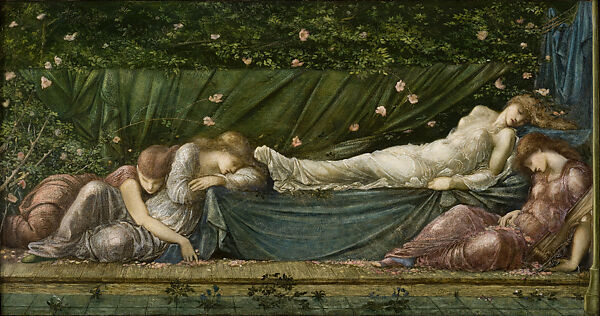
Burne-Jones gave the world back its dreams and innocence. He gave beauty back into a world of Realists, whether or not that was one of his goals. He once said, “The more materialistic science becomes, the more angels I shall paint.” In his Briar Rose Series, he created a fairytale that any adult could appreciate. In one of the images, The Sleeping Princess (fig. 8), the people are frail, angelic figures that make the fairytale seem almost real. This series of pieces is considered one of the masterpieces of high Victorian art. His reputation and work stretched as far as the British government, leaving almost no area in the world totally untouched.
Almost fifty years later, the surrealist painter Salvador Dalí said that he would like to paint like a Pre-Raphaelite. Dalí had an entirely different point of view on the imagination. He was trained as an artist from a very young age and was familiar with the masters when he started painting at twelve. He even copied some of his favorite styles to find the technique he liked. Reading Sigmund Freud’s Interpretation of Dreams changed his life. Dalí began to search the unconscious mind and the deep, dark dreams that no one ever talks about. He explored the symbols that explained the deep, disturbed nature of the human race.
Dali immersed himself in this world of Symbolism. He even created surrealist objects for window displays and designed surrealist hats. He thrived on the publicity and controversy that his artwork created. Later in life, though, he began to explore themes that seemed to show some Pre-Raphaelite philosophy. He started to paint things that were more spiritual and centered on the beauty of his wife, Gala. An example of this could be Saint Helena of Port Lligat (fig. 9). In this piece, he depicts his wife as the mother of Constantine the Great. He had shifted his pessimistic dream world into a realm more akin to the Pre-Raphaelite’s dream.

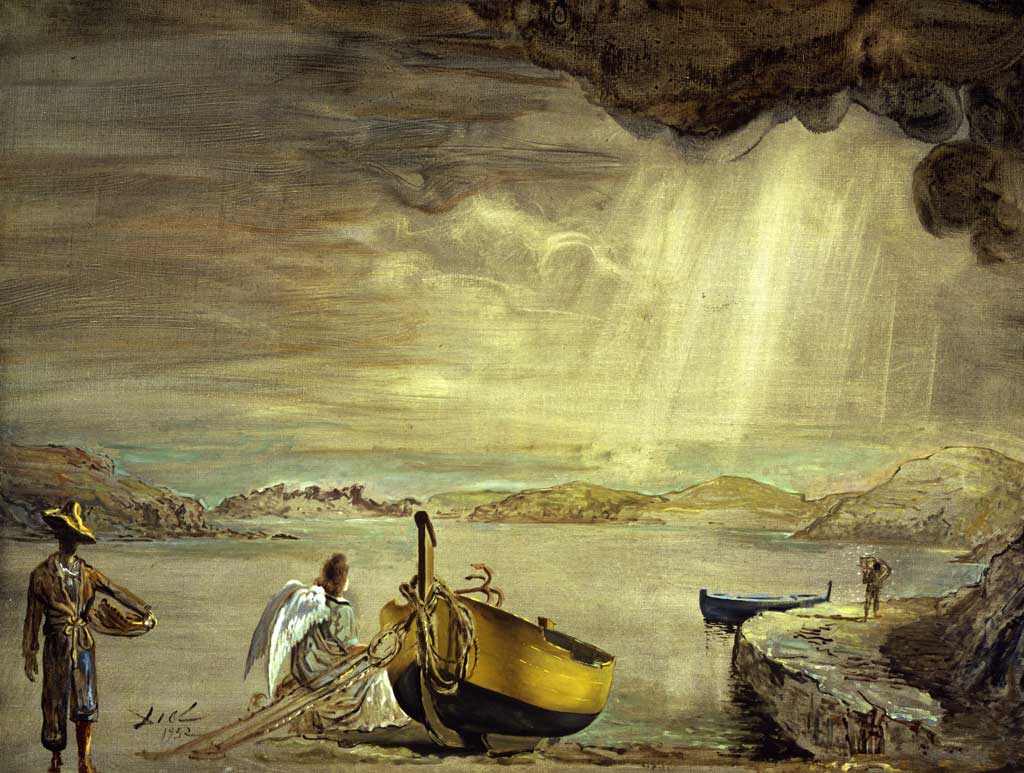
Dali, whose personality was almost the exact opposite of Burne-Jones, was probably influenced by him. Dali rediscovered the virtues that Burne-Jones painted while he was at Port Lligat. He once wrote, “The lucubrations of Paris, lights of the city, and the jewels of the Rue de la Paix, could not resist this other light – total, centuries-old, poor, serene, and fearless as the concise brow of Minerva.” He painted many pictures of Port Lligat while he was there. He focused on the rays of light in his The Angel of Lligat (fig. 10). The angel seems to be watching this play of light instead of causing it. The principles and philosophy of Burne-Jones’ style seem like something that no one can truly escape. Every artist is born with a sense of beauty, yet Burne-Jones knew how to focus entirely on it.
The Pre-Raphaelite movement was very influential, yet today in America we hardly ever even hear of it. We think its art is cute and we do not understand that it affected the world at that time. Burne-Jones created light when all around him he saw darkness. He is considered one of the best painters of the Pre-Raphaelite movement and influenced Victorian society a great deal. He did not take what was given to him; he redefined it. He was part of the Pre-Raphaelite movement, but he also helped it endure. He stood out because he believed that the mechanical world should not be our focus; the good qualities, character, and morals that humanity can accomplish should be our focus. Even today, we have not changed from the Victorians, because we trust in our fancy machines called computers.
The Pre-Raphaelites were called dreamers, but they made their dreams a reality in their own way. “They are the only rebels who have so far appeared against the industrial system and ‘mechanized living’ as we know it, except, perhaps, for the Surrealists, who have, to some extent, consciously imitated the Pre-Raphaelites in living a life of the imagination. The Surrealists are cynical and despairing. The Pre-Raphaelites were optimistic; they believed in beauty. The optimism of the twentieth century is differently directed. Its blind trust is placed in machinery. This trust is so strong that any alternative is ridiculed.” – Gaunt
Check out my young adult fantasy fiction novels HERE for something optimistic and fun.
If you like this article, consider subscribing to my quarterly newsletter.
Works Cited
Gaunt, William. The Pre-Raphaelite Dream. New York: Schocken Books. 1966
Lubar, Robert S. The Salvador Dali Museum Collection. Boston: Bulfinch Press. 2000
May, Stephen. The Art of Burne-Jones. British Heritage: Dec98/Jan99, Vol. 20 Issue 1
Reynolds, Graham. Victorian Painting. London: Studio Vista. 1966
Waters, Bill. Burne-Jones-A Quest for Love.<http://www.victorianweb.org/victorian/painting/bj/waters1.html>. The Victorian Web. 3/19/02
Welby, T. Earle. The Victorian Romantics. Hamden: Archon Books, 1966
Welland Ph.D, D.S.R. The Pre-Raphaelite in Literature and Art. London: George G Harrap’s Co LTD. 1953
Wood, Christopher. The Pre-Raphaelites. London: Seven Dials, Cassell & Co. 2000

What do you think?