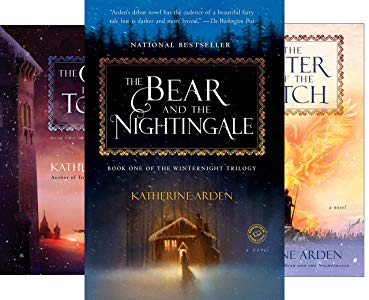
I usually review only one book at a time, but since I haven’t written a review of any of these books, I am going to review the whole Winternight Trilogy in this single post.
First of all, before I even get to these amazing books, I have to say that I have never seen more beautiful book covers in my life. The artist and graphic designer in me can’t get enough of this artwork. I wish I could say that the cover didn’t influence me, but then I would be lying. It is nearly impossible to not be influenced to buy a book by its cover. These covers truly portray both the magical fairy tale feel of the stories and hint and the Russian context (perhaps heavier on the fairy tale aspect, though). I could easily just frame these covers and put them on my wall. I am tempted to buy the poster, but I don’t think my husband would appreciate that, and I don’t think it would match my decor. If I were still in high school or college, I would totally do it!
OK, so now to the books:
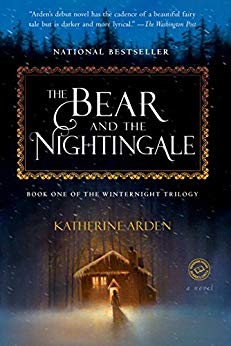
The Bear and the Nightengale is the first book in this trilogy. I had bought the book over a year ago, thinking it would be a stand-alone novel, and, in some ways, a person can read it that way. This novel is an expanded version of the common Russian fairy tale about two girls being left outside, in turn, in the middle of winter and their encounter with the Winter King. There is much more to the book than that, but it is clear that was where the author started.
The book starts with Vasya’s mother, siblings, and nurse in early Russia, around the 1300s. Vasya is a prophesied daughter who is born during winter, which causes her mother’s death. Vasya grows up somewhat wild and sees the unseen creature from Russian folklore. Her father remarries a woman who hates Vasya, but for the most part, life continues until the Winter-King, Morozko, takes an interest in her as well as his twin brother, the bear. She is caught in a magical battle between good and evil that keeps you captivated.
This is such a beautiful book with an interesting mix of history and folklore. Vasya’s feminist tendencies are not very consistent for the time, but considering all the ways the book has to diverge from reality, this doesn’t bother me much. The book is a self-contained adventure, but when then the book ends, you really want to know more about what happens to Vasya and Morozko. I think this is perfect for a trilogy since I hate a cliffhanger ending.
The beginning of the book is a little slow in setting up Vasya’s birth and upbringing. In my opinion, her prophetic existence isn’t really necessary to the plot. The story of her mother and grandmother becomes more important in future books, but in this novel, the true plot of this story picks up about halfway through. Still, the world and characters were so compelling that I couldn’t put the book down. The world of mythological Russia during the 1300s was as compelling as the characters, and I never felt like the book’s pace lagged.
Overall, the book is pretty clean but not necessarily the ideal book for young teenagers. There is no cursing and minimal violence (physical abuse from a step-parent, cutting one’s hand to give blood to these mythical beings, and a zombi-ish being). It is very frank about marriage and the marriage bed, but there are no sex scenes. Still, there are some adult themes and a level of grittiness in losing beloved characters.
Also, in this first book, the church (especially a certain priest) is set up as one of the villains. This doesn’t carry through the other books and isn’t consistent. Later in the series, you do meet both good and villainous people in the church.
This is a great first book!
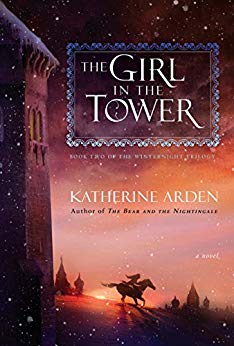
The Girl in the Tower continues the story from The Bear and the Nightingale. Vasya must leave her village now that everyone thinks she is a witch, and she ends up in Moscow. She encounters the villainous priest and a sorcerer who threaten both her family and the city. We see more of Morozko and learn more about Vasya’s family history. Again, this is another self-contained adventure with a satisfying conclusion, but you still want to know what happens next to the characters.
Some themes are repeated from the previous book: Vasya doesn’t want an arranged marriage or to go to a convent. There are also some familiar villains, but the conflict is very different from the first book. Vasya and all the characters do grow and develop from one book to the next. The relationship between Vasya and Morozko also changes and grows. We also learn of the politics of Russia and the threat of the Tartars. The physical and fairy tale are entwined very well.
Again, this book is pretty clean but a little gritty for the youngest teenage readers. No cursing, some violence, and frankness about sex without a sex scene. The church is not the primary villain in this book, and you meet both good and bad priests.
This novel is a nice bridge between book one and book three without slowing down or feeling incomplete. In fact, I think this book had better pacing than the first book, with a compelling plot that continued to pull you forward and gain momentum.
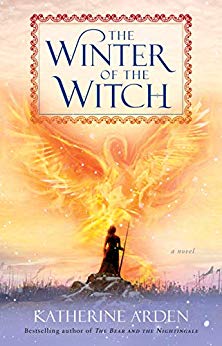
The Winter of the Witch is the conclusion of this trilogy. I was honestly very nervous going into reading it because so many trilogies and series fail to deliver on all their promises in their concluding book. I put a lot of weight on how a book and series ends. This book does deliver, but with a couple of minor disappointments.
The beginning of the book takes place immediately after the previous book. Vasya is taken by a mob, and they try to burn her as a witch. She escapes and launches into a fight to save all of Russia, both seen and unseen. Morozko is imprisoned when he frees the bear to save her life. She then goes to free him and imprison the bear. I feel like her relationship with Morozko is spoiled a bit with an unnecessary scene (trying not to give away a spoiler). After a powerful conclusion to this conflict, our attention is brought back to the conflict with the Tartars. Vasya learns that she must strive to unite Russia, seen and unseen, the church and the pagan, to win this war.
The ideal in this novel is that the church and the pagan can co-exist. In the back of the book, the author points out this does happen in Russia for a long time until the Revolution. I also know many other countries have this happen commonly. I personally don’t feel like this is good, ideal, or healthy in real life. For the sake of this fictional story, I suspend my personal belief to appreciate that the characters are trying to achieve peace. I do believe that wise readers must be aware of ideas such as these that sound good in a fictional world but don’t work in reality. I could hijack this review with all the reasons why I feel this way, but I will let this go and allow the reader to just be aware of this message and take the stance they choose on the subject.
This book does continue its compelling pacing, and I couldn’t put the book down. The conclusion was satisfying, and all the promises were met. I enjoyed the surprises and twists as well.
This book doesn’t have any cursing, but it does have more violence than the other books, a sex scene, and some gritty themes. The sex scene is not explicit, but I found its existence disappointing and unnecessary to the plot. I know some readers think sex is romantic on its own, but for me, the lack of commitment to each other by those involved shows a lack of understanding of human psychology or what love actually is. I wasn’t even sure that the female character completely fell in love, or at least she didn’t admit it at that time. To me, this ruined so much. The excuse that vows in a church is not binding to immortal beings was silly. These same beings were making other kinds of binding vows throughout the book. Without any love or binding vows, the freedom this character fought for was thrown away in a moment. The mess of emotions the characters felt afterward would be accurate and put a huge damper on the security they had felt with each other.
So, this book was fascinating with a great ending and a great plot but had a couple of disappointments that I will probably rewrite in my imagination to feel content.
The whole trilogy was well-imagined, well-written, and satisfying in pacing and plot. I love the mix of folklore and history. I loved the characters and the way they grew. If the last book had been just a little better, this could have easily become one of my all-time favorite trilogies. As it is, I will probably read it again and sigh over the problems when I do. I can easily recommend this series to adult readers and perhaps older teens who can handle some of the more mature issues about feminism and sexuality without being persuaded by the fictional emotions of a beautiful book.
Check out my young adult fantasy fiction novels HERE for something optimistic and fun.
If you like this article, consider subscribing to my quarterly newsletter.


Leave a reply to Lara Lee Cancel reply