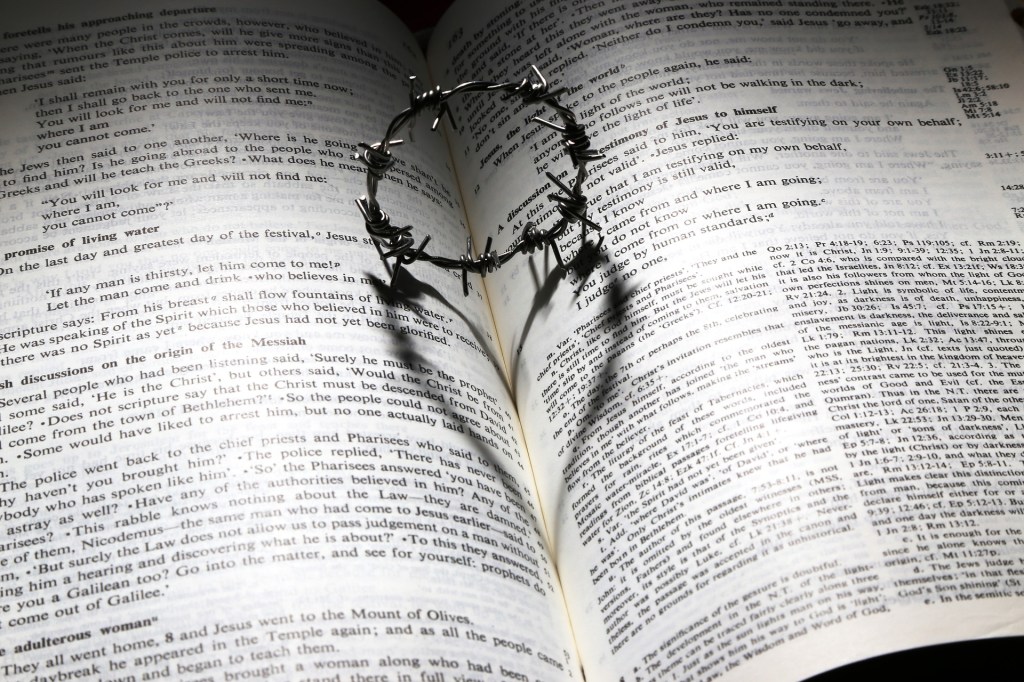
2 Corinthians 12:7-10 (ESV)
… a thorn was given me in the flesh, a messenger of Satan to harass me, to keep me from becoming conceited. Three times I pleaded with the Lord about this, that it should leave me. But he said to me, “My grace is sufficient for you, for my power is made perfect in weakness.” Therefore I will boast all the more gladly of my weaknesses, so that the power of Christ may rest upon me. For the sake of Christ, then, I am content with weaknesses, insults, hardships, persecutions, and calamities. For when I am weak, then I am strong.

Disability is the kind of taboo topic that stays perpetually hidden like the hole in a wealthy businessman’s $60 pair of socks. He smiles with his straight bleach white teeth, every hair slick with gel, and sporting the latest fashionable suit, but he has an uncomfortable flaw than he just pretends doesn’t exist. Why doesn’t he fix it? He either doesn’t have the time or doesn’t know how. Why doesn’t he just throw the sock away? Because he paid sixty whole dollars for those darn things! Are you nuts! As long as there are penny-pitching millionaires, there will be holes in $60 socks, I promise you.
As long there are people with disabilities, the issue of where they fit in the church will continue to exist. Just to be clear, I am not calling people with disabilities a hole in a sock. I am calling our lack of theology about disability a hole in a sock. We need to fix it and stop ignoring it.
The church often wants to look perfect, with its perfect God. Congregations gather in expensive buildings, their ramp for wheelchairs nicely tucked away by a side door that no one can see and is often locked. The sign-language interpreter signs pigeon or signed English instead of ASL to a group of hearing individuals who think it’s a beautiful hobby. Christians give generously to hospitals and special needs programs that give away useless trinkets that do nothing to make peoples lives better in the long run. Church people can be very kind and sympathetic to those with a disability, but there is a lack of understanding of what it is like to be disabled in the church. I believe this is why there isn’t a theology for it. We just gloss over the fact that disability exists when we teach about a God who heals “everyone” and then move on with our perfect theology of our perfect God…
… until we become the one disabled.
Suddenly, the world changes. You aren’t useful in the church anymore; you’re pitied. You aren’t expected to contribute; you’re just supposed to take charity. You are told God loves you, but you are expected to sit on the sidelines of life and let others do the real work, the real ministry. What this says, though, is God might love you, but he has no use for you. The church doesn’t really know why that happened to you, and so their theology implies you are to blame. You’re told we don’t ever blame God. It couldn’t possibly be his fault. That would ruin the image of a perfect God. The businessman has a hole in his sock.

As a mom of two special needs kids, one with autism and on who is deaf, I find myself wondering who is to blame when a child is born disabled? What is God’s plan for them? Are they to spend the rest of their lives begging God to heal them or do they just exist as second-class Christians? Do we expect them to just receive pity and charity from the church and yet not be valuable for themselves?
One of the things a sick or disabled person often hears is “don’t blame God,” because it is implied to blame God is to say God has done something wrong and evil. This argument doesn’t work. God is sovereign. He created everything and is more powerful than anything. We see Jesus heal over and over again in the Bible. When disability exists, it’s because God allows it to exist. Exodus 4:11 (ESV) says, “Then the Lord said to him, ‘Who has made man’s mouth? Who makes him mute, or deaf, or seeing, or blind? Is it not I, the Lord?’”
Standard church theology says it’s human sin that caused the disability in the first place, but what about those born disabled? Who sinned (John 9:1-40)? God in his greatness did not prevent it or heal that child was born disabled. To say it is from human sin implies that God can’t do anything about sin. What happened at the cross then? What about the verse in Isaiah 53:5 “But he was pierced for our transgressions; he was crushed for our iniquities; upon him was the chastisement that brought us peace, and with his wounds, we are healed.” (ESV) Are we saying, “Oops, disability is bigger than God”?
Job’s friends thought the same thing as us when they say in Job 34:10, “Therefore, hear me, you men of understanding: far be it from God that he should do wickedness, and from the Almighty that he should do wrong..” (ESV), but God can heal anyone he wants at any time. We see it happen from the beginning of the Bible to the end. Was this disability a surprise to God? Did it show up, and God said: “Oh my! I never meant that to happen.”
God created some people disabled (Exodus 4:11).
On purpose (John 9:1-40).
Intentionally (2 Corinthians 12:7-10).
Paul says clearly that he was GIVEN a thorn in the flesh.
That makes us uncomfortable because we don’t understand how this can be true, and God be good at the same time. Brain overload… does not compute… (imaginary robot wobbles as gears grind, spews smoke from the sides of his head, and then falls over, lifeless)

Well, it’s like this: I am known for being a decent cook, but I am also known for not following directions. It isn’t that I don’t understand the instructions or that I forget to do specific steps. Nope. I stubbornly choose, nearly every time, to change the recipe. Since I am not perfect in my choices either causes phenomenal successes or disastrous failures. I don’t do in between.
Once, when I was home from college, my mom wanted me to cook a pot roast. I’ve never made pot roast. So, she gave me a Betty Crocker recipe that she had used once. It was simple, reliable, and sure to work.
Like always, I changed the recipe. Instead of using beef broth for the liquid, I used water and a jar of horseradish. If you have ever tasted horseradish, you now know that I like to live life dangerously. I cooked the beef at a lower temperature than the recipe said and for hours longer. I chose to do this deliberately because I thought I could make the food better than the recipe… plus I’m just pig-headed like that.
When my mom tried the pot roast, she loved it! It was a huge success. My grandmother liked it, and all the men in the family got seconds. Nothing remained for leftovers. Then, my mom found out that I had changed the recipe. She is a natural rule-follower, and this bothered her continually. For the rest of her life, we disagreed (in a friendly way) about how to cook pot roast. It is one of my biggest triumphs of pure orneriness.
So how is this like God when he created individuals with disabilities?
You see, God doesn’t follow our recipe for life. We like everything to work in a predictable pattern that we know always works. The majority of Christian self-help books assumes each of us has the same patterns of life, with the same problems, and the same spiritual battles. This isn’t a bad thing. It’s the way God made the majority of us. What if God diverged from the pattern, though, for a purpose, making something better for his plan in a specific place and time (Esther 4:14)? What if normal and average weren’t what would show his glory the best (1 Corinthians 1:27)? What if God could do better than his typical recipe?
Am I saying that being sick or disabled is better than being healthy and whole?
Yes. Sometimes it is.
I am NOT saying disability is good in of itself. It isn’t fun. It isn’t easy. None of us would choose it for good reasons. What I am saying is God turns disability around for good (Romans 8:28-39).

Paul says in my starting verses, “In my weakness, he is made strong.” God shines when we lean on him for our strength and not on ourselves, disabled or not. God didn’t use Paul despite his disability either. I am going to argue that it was because of this thorn in his flesh that Paul was BETTER qualified for the ministry God was using him in. Paul isn’t the only one God didn’t heal either. Next week, we will walk through the Bible so we can see all the heroes God “forgot” to heal. Then in part 3, we will talk about why God heals … and doesn’t heal, and in the last part, we will talk about what disability in the church should look like.
If you are one with a disability, know one thing for certain: God loves you just as much as everyone else. Just like Paul, you have been created as you are on purpose and with a purpose in mind. Please stay with me as I show you that God made no accidents. If Paul, who prayed for healing for everyone around him and saw it come to pass, still had a thorn in his flesh, then your disability is not because of a lack of faith or God not loving you enough. I promise. I’ll show you. I just didn’t want to rush through all of this research and have so many points that no one could remember it. There is a lot in the Bible on this topic, but we, the church, just haven’t put the time into searching for it. You are not alone!


Leave a reply to Devotional: Oops, God forgot to Heal Paul – Something Resembling a Theology of Disability -Part 4 of 4 by Lara Lee – Lara's Wanderings Cancel reply