2 Corinthians 12:7-10 (ESV)
… a thorn was given me in the flesh, a messenger of Satan to harass me, to keep me from becoming conceited. Three times I pleaded with the Lord about this, that it should leave me. But he said to me, “My grace is sufficient for you, for my power is made perfect in weakness.” Therefore I will boast all the more gladly of my weaknesses, so that the power of Christ may rest upon me. For the sake of Christ, then, I am content with weaknesses, insults, hardships, persecutions, and calamities. For when I am weak, then I am strong.
Yesterday, in Part 1, I covered the fact that we, the church, are uncomfortable with disability and don’t really have an explanation for why God allows it to exist. My proposal was that God allows… even gives disability on purpose. Now, we are going to see where in the Bible, other than Paul, I could possibly get such an idea.
Let us start with Issac, my personal favorite example. Dr. Kerry Lee wrote a paper that looks at the passiveness of Issac in the book of Genesis and identifies many of the core symptoms of a person on the autistic spectrum listed in the (DSM-5) that psychologist used to diagnose it.

We see from the beginning, Ishmael makes fun of Issac even as a child when autism is most visible (Genesis 21:9). As he gets older, Issac is passive when his father tries to sacrifice him (Genesis 22:1-19). Issac doesn’t even go out to chose his own wife, but lets his father do it for him (Genesis 24). Have you ever wondered why Abraham’s servant prayed for God to lead him to a woman who would give water to 10 camels? All-knowing Google says that each camel would drink about 30 gallons. So she hauled 300 gallons of water! It seems like Abraham’s servant was looking for a responsible woman capable of caring for a full-grown autistic man with an enormous household. He was expecting that she would be working hard instead of being the pretty–little–thing of a rich man. Issac mimics his father’s choice to hide the fact his wife is married to him in Egypt even when this doesn’t make much sense (Genesis 26:6-11).
There is no way to diagnose a disability like this after the fact, but the symptoms of autism was not studied and recorded until the 1900s. Issac could have had a number of disabilities with or instead of autism. The nature of Issac’s struggles has to be speculation. Anyone in the past who had these struggles was just dealt with as they were, oddities and all. So is this passive, autistic-like personality useless? Is Issac pushed out of the picture because he isn’t as “normal” as his father, wife, or sons?
No, Rebecca leans on him to pray for her when she couldn’t have children (Genesis 25:21). God hears Issac because he has a personal relationship with God. Even strangers could see Issac’s relationship with God (Genesis 26). Even when Issac seemed to be sick or dying for nearly thirty years (enough time for Jacob to leave, get married twice, have twelve sons and come back again. See Genesis 35:27-29), he had a blessing to give. God was still using him. The Israelites called God the God of Abraham, Issac, and Jacob (1 Kings 18:36). God even refers to himself as the God of Abraham, Issac, and Jacob (Exodus 3:6 and Mathew 22:32, Mark 12:27, Luke 20:38). Issac isn’t included just because he was Abraham’s son or Jacob’s father; he had his own faith. This faith in God kept him in the footsteps of his father rather than moving back to Rebecca’s family or to a nearby town. He, as he was without being healed, was being used by God even with a disability… and used enough to be remembered by us thousands of years later for his faith.

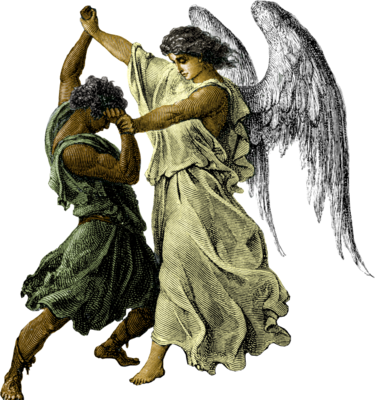
Jacob, Issac’s son, wasn’t born disabled. He was in perfect health as far as we know. Instead of leaving him that way, God actually made him disabled… on purpose. In Genesis 32:22-31, when Jacob wrestled with the angel for a blessing, Jacob was then named Israel, promised a large family, and then knocked his hip out of joint as a sign of interacting with God.
That doesn’t sound right. We are often told in the church that everyone who interacts with God/Jesus gets healed. Wouldn’t God injuring Jacob be a curse rather than a blessing? I don’t typically see a person with an injury and think, “Oh, God gave them that. Isn’t that great?”
We are not taught that Jacob’s limp was part of God’s blessing, but what if it was? What if God was saying to Jacob, “enough fighting, now it’s my turn to fight your battles.” Can you imagine Jacob going to war with his brother Esau while limping? Not happening. He would get killed. In Jacob’s weakness, God was showing he had won the battle already. This, though, is not the end of the story. Even with Jacob’s disability, he is an essential character for the rest of the book of Genesis. Jacob/Israel makes choices, prays, and blesses up until the end chapters.

In Exodus, Numbers, and Deuteronomy, our main character is Moses, who has a speech problem. It’s speculated he stuttered. God uses Moses without ever healing him. Instead, Arron speaks for Moses, but this wasn’t God’s original plan. God chose, on purpose, a prophet, one who declares, with the precise disability to disqualify him. Oops. Do you think that was an accident? No chance.
Can you imagine living your whole life in fear of public speaking and then being asked by God to confront one of the most powerful men in the world at that time, Pharaoh, a man who believed he was a god? Can you imagine leading thousands of people when you struggle to speak? A great movie to watch is “The King’s Speech” about King George VI of England and his speech problems. This movie shows how people disqualified King George VI from being a good ruler because of his speech problems, and why it was so important to overcome his disability. It’s a fantastic movie, but Moses didn’t have a radio to help him communicate, he had Arron. Still, the daily struggle of talking to leaders and giving advice would have been embarrassing and difficult. Moses had to lean on God, and that was Moses’s real strength in the end.
In Judges 3:12-30, we meet Ehud, a left-handed man. Many scholars believe that back then left-handedness was viewed as a disability. It is interesting to imagine a disability that today is not a disability. At the same time, we live in a right-handed world. I am continually telling my son’s teachers that he is left hand because they immediately start pushing for him to use his right hand, his weaker side. In biblical days, swords were made with a single blade for right-handed people, but the Bible says Ehud made a double-edged sword, one that could be used with either hand. His world was so right-handed that over and over again everyone around Ehud makes assumptions that he would fight right-handed. Yet, he is able to sneak in a weapon into the Moabite palace because he had it strapped to the opposite side of his body than everyone else. His “disability” became his asset to deliver Isreal from oppression.
There may be more in the Bible who lived with disability, but they are more hidden. I know many women in the Bible struggled with infertility. We assumed they all eventually were healed, but why was a princess of Egypt so eager to adopt a Hebrew slave boy (Moses)? Could it be all the other women in the royal court had children, and she had none? This would have put her at a political and economic disadvantage in a society that expects one’s children to be their retirement insurance. Is infertility a disability? When it means that you can’t live like the rest of the community or have to sit in church every mother’s day and hear about families that you can’t create, perhaps it is. What I know is that God used a physical deviance for good. Pharaoh’s daughter’s infertility is entirely speculation, but there are many places in the Bible in which this type of speculation fills the gaps.

Jesus was asked why a man was born blind (John 9:1-3). Jesus answered that it was so God’s glory could be seen. Most people teach that passage as though this man’s entire life had been pointless until the moment he was healed. Would God really create a person for just one moment in time and forget about him the rest of the time?
If you read the whole story (John 9:1-40), this man had a mature and profound faith in God already. He eagerly believed in Jesus once he was healed. That faith didn’t start right at that moment. The character of this blind man had been developing through years of faith before that moment. The passage clearly said that the whole neighborhood knew him. When the Pharisees questioned him about his healing by a man they knew nothing about, in verses 30-33, “The man answered, ‘Now that is remarkable! You don’t know where he comes from, yet he opened my eyes. We know that God does not listen to sinners. He listens to the godly man who does his will. Nobody has ever heard of opening the eyes of a man born blind. If this man were not from God, he could do nothing’” (ESV). These are the words of someone who was spiritually mature, someone who has been thinking about God a lot. A life that wasn’t bitter, but had already been glorifying God. The healing only justified this man’s already established faith and pointed it specifically to Christ.
So we come back to Paul.

In 2 Corinthians 12:7-10, Paul says that a thorn was given to him in the flesh. Some has speculated that this thorn was a disability. Some have pointed to places in scripture in which it seemed like Paul had vision problems (Galatians 4:13,15, Galatians 6:11, Acts 23:4–5) . Other people have speculated that it was epilepsy. Whatever it was, Paul prayed to be healed, and God said no. Paul even claims that he was given this “thorn” so he couldn’t boast– to make him weak. He tells us this was done on purpose.
Why?
In verse 9, God says, “My grace is sufficient for you, for my power is made perfect in weakness.” So what does that mean? This doesn’t sound like God is using Paul DESPITE his disability. It looks instead that God’s power is made perfect BECAUSE of Paul’s disability. It seems like God wanted to do something better than his typical “recipe.”
As we had seen with our walk through the Old Testament, God used people who were most unlikely to be qualified to the job he called them to. In themselves, the task would be impossible, but with God, all things are possible. We lean harder on God when we need him the most. Often, that is where God wants us. He makes our weakness, or disability, become our asset. It is undeniable that Issac, Jacob, Moses, and Paul did extraordinary things that people without any kind of limitations would still be unable to do. The difference was their relationship with God. He made them as they were for a reason, and they trust God in that.
Next week, I am going to cover why God heals at all. If God can use disability (I won’t say it is good in of itself, because honestly, it’s awfully hard!), then why does God heal some people? Why not leave everyone as they are? Then the week after that, I am going to cover what I believe is God’s vision for disability in the church, and I’m not alone in my views. Each one of us was created for a purpose, and each of our lives has meaning. I am hoping this journey will help you see yours!
Proverbs 3:5-6 (ESV) Trust in the Lord with all your heart, and do not lean on your own understanding. In all your ways acknowledge him, and he will make straight your paths.


Leave a reply to Devotional: Oops, God forgot to Heal Paul – Something Resembling a Theology of Disability -Part 4 of 4 by Lara Lee – Lara's Wanderings Cancel reply