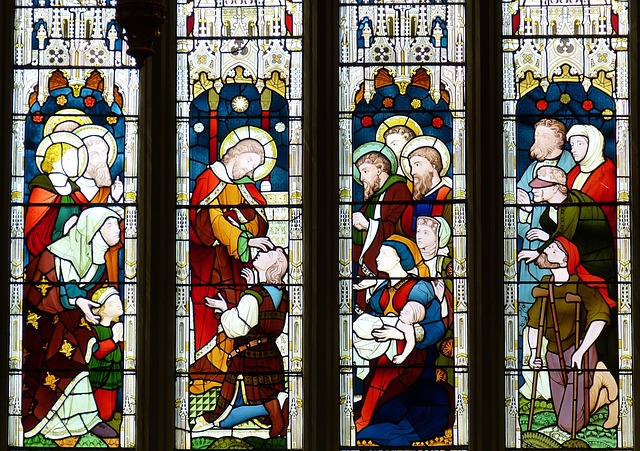
2 Corinthians 12:7-10 (ESV)
… a thorn was given me in the flesh, a messenger of Satan to harass me, to keep me from becoming conceited. Three times I pleaded with the Lord about this, that it should leave me. But he said to me, “My grace is sufficient for you, for my power is made perfect in weakness.” Therefore I will boast all the more gladly of my weaknesses, so that the power of Christ may rest upon me. For the sake of Christ, then, I am content with weaknesses, insults, hardships, persecutions, and calamities. For when I am weak, then I am strong.
In Part 1, I covered the way the church is uncomfortable with disability, and its hesitancy in blaming God for allowing it. In Part 2, I showed how many characters in the Bible were disabled, and God used them as they were, in their weakness. If you haven’t read these posts, please do, because today’s discussion won’t make much sense.
SO, if Isaac, Jacob, Moses, and Paul were disabled, and God refused to heal them, why does God heal anyone? Why not leave things as they are? This is an unusual question. It’s kind of an Alice in Wonderland sort of view in which everything is backward. In the church today, we assume that God SHOULD heal. In fact, while I was researching for this article, I found many places online that said Jesus healed everyone in the Bible he met and that Paul could not possibly be talking about a physical illness at all because he had encountered the risen Christ, but both of these statements are not true (Luke 4:27). These articles say if we aren’t healed, we are doing something wrong. I agree that we should pray for God to heal us, and many scriptures say that God will heal (Mathew 10:8, Isaiah 53:5, 1 Peter 2:24, Luke 10:9). I am NOT saying we need to stop this. Instead, I want to say that it is okay for God to say no to our prayers for healing. This isn’t doubting, lack of faith in God, or some kind of sinful flaw when God says no. Sometimes God heals. Sometimes he doesn’t.
The reason I bring this issue up is because if being disabled brings glory to God, wouldn’t being healed take away from that?
The answer is no.
Healing also brings glory to God, which is why Jesus did so much of it, and it continued on through his followers. (I now imagine my readers wrinkling up their faces, tilting their heads, and saying “Huh?”) So, in summary, being healed gives glory to God, and NOT being healed gives glory to God.
Umm… Doesn’t that mean that no matter what happens, God gets the glory?
Yep. You win a sticker.
You see, healing actually doesn’t last. Every single person God has ever healed on this earth has, at some time died anyway. It just doesn’t endure for us mortal beings. Sometimes, those healed got sick again with something else or disabled again. I have heard people disqualify healings and recovery being from God because it doesn’t “stick.” This is nonsense.

I may stretch standard theological thought for some people by saying healing is not for the body to be made whole. It’s about healing the spirit which is connected to the body. Your body is not your enemy, but it isn’t the point of our lives either. Disability and healing can both bring glory to God and benefit to ourselves because of what it does to our spirit: our relationships, our character, our attitudes, our ministry, and more.
Jesus demonstrates this when he forgives sins, and healing then follows. It is also shown in how healing brought about faith in the one healed. In the book Healing: Sign of the Kingdom by Dr. Howard M, Ervin, he explains that the word used for the messianic sign of healing is the same as eternal salvation. Another words, the faith that heals is the same faith that saves, and the faith that saves is the same as that which heals. So, it isn’t “faith that God will heal me” that God is looking for. He is looking for “faith that God will save me; however, he decides to do that.” We are called to have faith in God, not faith in healing. Does that make sense? Dr. Ervin says, “Signs are for the unbelievers. Christians, having already believed in the gospel, do not need signs to confirm their faith.”
I would then say, it is the stronger ones who are not healed, not by choice though. A Christian who has faith while being disabled has a pretty solid foundation for their understanding. We were not called to an easy Christianity, and a lot of “well” Christians get rocked by trials when they come. Those who are disabled have already been there and done that.
The point I am trying to make is that God is not a robot. You don’t do x, and then y always happens. (Que Monty Python paper cutout God appearing in the sky acting like R2D2 – or maybe that’s just me geeking out). Healing and even church theology often try to make absolute statements about how God works. For certain points in our doctrines, absolute statements are essential: Jesus is God, Jesus died for our sins, Jesus is coming again, etc. Some things, though, cannot be taught as absolutes, such as how God grows the human heart and how he works the events of our life for good. In this, we must remember God is a person, working in relationship with us. What he does for Mr. Smith he may not do for Mr. Diaz. This is because God knows the heart and the future.

It’s like this: my oldest son likes robots and my youngest son like stuffed animals. Would it make sense to give both of them robots? No, because my youngest son wouldn’t have any use for a robot. Then, perhaps, I should give them both of them stuffed animals? No, because my oldest son has no use for stuffed animals. I give each what is most appropriate for them.
So should a disabled person pray for healing?
Of course! Jesus healed many who had been disabled from birth. In James 5:13-15, we are specifically told to go to the elders of the church to pray for healing. We also know that God can change his mind. Hezikiah was able to convince God to extend his life (2 Kings 20:5). I have always prayed for my sons and will continue to pray.
What I am trying to say, though, is that a healed person is not a better Christian than a disabled person. A person’s faith is not the only factor in whether or not a person gets healed. Just because God says no to healing does not mean God loves that person less. God has a reason to heal and a reason not to heal. He sees the future and is using EVERYONE who follows him in that plan.
It’s like when I visited the pilgrimage church, Maria Dreieichen, in lower Austria. I was with a tour group from my school, and we had just seen palaces and cathedrals around Europe. We came to this white church in the middle of nowhere. It was elegantly pretty, but not like the palaces we had seen and simpler than many of the cathedrals. The tour guide told to remain quiet since it was a church that was in use. Believers may be there praying. We entered the church, and on the ceiling was the most magnificent mural I had ever seen with pink clouds, cherubs looking down on us, and amazing heavenly imagery. It was like the sky had opened up, and you could see God and his court. I was so entranced by the ceiling that I tripped over a pew which reverberated throughout the sanctuary.
As Christians, we often get distracted by the beauty and glorious miracles in the Bible. They are wonderful, but there is more to the Bible than healing. God often uses a full range of human experiences to try to help us understand the point. The healings in the Bible is not the church, nor is it the entire doctrine of Christianity. They were signs to reveal who Jesus was, and in the Old Testament, to reveal that God was present. Being healed is not essential to our faith, just like a mural is not essential to a church building. It’s just nice to have.

God allows us to go through the trials of illness and disability for a reason. The trials we face in this life, all of them of various kinds, do have a purpose. Goodness! That’s what a good portion of the Bible is about. Here are a few verses to remind you that we all were called to suffer and endure trials:
James 1:12 (ESV) Blessed is the man who remains steadfast under trial, for when he has stood the test he will receive the crown of life, which God has promised to those who love him.
1 Peter 5:10 (ESV) And after you have suffered a little while, the God of all grace, who has called you to his eternal glory in Christ, will himself restore, confirm, strengthen, and establish you.
Romans 12:12 (ESV) Rejoice in hope, be patient in tribulation, be constant in prayer.
James 1:2-8 (ESV) Count it all joy, my brothers, when you meet trials of various kinds, for you know that the testing of your faith produces steadfastness. And let steadfastness have its full effect, that you may be perfect and complete, lacking in nothing. If any of you lacks wisdom, let him ask God, who gives generously to all without reproach, and it will be given him. But let him ask in faith, with no doubting, for the one who doubts is like a wave of the sea that is driven and tossed by the wind. …
1 Peter 4:12 (ESV) Beloved, do not be surprised at the fiery trial when it comes upon you to test you, as though something strange were happening to you.
Romans 8:18 (ESV) For I consider that the sufferings of this present time are not worth comparing with the glory that is to be revealed to us.
Romans 8:28 (ESV) And we know that for those who love God all things work together for good, for those who are called according to his purpose.
Philippians 4:13 (ESV) I can do all things through him who strengthens me.
1 Peter 1:6 (ESV) In this you rejoice, though now for a little while, if necessary, you have been grieved by various trials,
Acts 14:22 (ESV) Strengthening the souls of the disciples, encouraging them to continue in the faith, and saying that through many tribulations we must enter the kingdom of God.
1 Peter 1:7 (ESV) So that the tested genuineness of your faith—more precious than gold that perishes though it is tested by fire—may be found to result in praise and glory and honor at the revelation of Jesus Christ.
Psalm 34:19 (ESV) Many are the afflictions of the righteous, but the Lord delivers him out of them all.
Joshua 1:9 (ESV) Have I not commanded you? Be strong and courageous. Do not be frightened, and do not be dismayed, for the Lord your God is with you wherever you go.”
Philippians 4:7 (ESV) And the peace of God, which surpasses all understanding, will guard your hearts and your minds in Christ Jesus.
2 Corinthians 4:16 (ESV) So we do not lose heart. Though our outer self is wasting away, our inner self is being renewed day by day.
Romans 5:2-5 (ESV) Through him we have also obtained access by faith into this grace in which we stand, and we rejoice in hope of the glory of God. More than that, we rejoice in our sufferings, knowing that suffering produces endurance, and endurance produces character, and character produces hope, and hope does not put us to shame, because God’s love has been poured into our hearts through the Holy Spirit who has been given to us.
1 Thessalonians 5:16-18 (ESV) Rejoice always, pray without ceasing, give thanks in all circumstances; for this is the will of God in Christ Jesus for you.
2 Corinthians 1:3-4 (ESV) Blessed be the God and Father of our Lord Jesus Christ, the Father of mercies and God of all comfort, who comforts us in all our affliction, so that we may be able to comfort those who are in any affliction, with the comfort with which we ourselves are comforted by God.
1 Peter 4:12-13 (ESV) Beloved, do not be surprised at the fiery trial when it comes upon you to test you, as though something strange were happening to you. But rejoice insofar as you share Christ’s sufferings, that you may also rejoice and be glad when his glory is revealed.
Genesis 50:20 (ESV) As for you, you meant evil against me, but God meant it for good, to bring it about that many people should be kept alive, as they are today.
Revelation 3:21 (ESV) The one who conquers, I will grant him to sit with me on my throne, as I also conquered and sat down with my Father on his throne.
1 Peter 1:6-7 (ESV) In this you rejoice, though now for a little while, if necessary, you have been grieved by various trials, so that the tested genuineness of your faith—more precious than gold that perishes though it is tested by fire—may be found to result in praise and glory and honor at the revelation of Jesus Christ.
Isaiah 41:13 (ESV) For I, the Lord your God, hold your right hand; it is I who say to you, “Fear not, I am the one who helps you.”
2 Corinthians 4:17 (ESV) For this light momentary affliction is preparing for us an eternal weight of glory beyond all comparison,
Galatians 2:20 (ESV) I have been crucified with Christ. It is no longer I who live, but Christ who lives in me. And the life I now live in the flesh I live by faith in the Son of God, who loved me and gave himself for me.
Colossians 1:24 (ESV) Now I rejoice in my sufferings for your sake, and in my flesh I am filling up what is lacking in Christ’s afflictions for the sake of his body, that is, the church,
Romans 12:1-2 (ESV) I appeal to you therefore, brothers, by the mercies of God, to present your bodies as a living sacrifice, holy and acceptable to God, which is your spiritual worship. Do not be conformed to this world, but be transformed by the renewal of your mind, that by testing you may discern what is the will of God, what is good and acceptable and perfect.
Romans 8:17 (ESV) And if children, then heirs—heirs of God and fellow heirs with Christ, provided we suffer with him in order that we may also be glorified with him.
Isaiah 55:8-9 (ESV) For my thoughts are not your thoughts, neither are your ways my ways, declares the Lord. For as the heavens are higher than the earth, so are my ways higher than your ways and my thoughts than your thoughts.
Hebrews 2:10 (ESV) For it was fitting that he, for whom and by whom all things exist, in bringing many sons to glory, should make the founder of their salvation perfect through suffering.

If you have a disability, if the world has counted you out, if you are angry at God for doing this to you, I suggest you find out why he did it. It’s probably not the answer you were expecting. Something about who you are, broken pieces and all, was created to give glory to God and do things no one else could do. What is that unique thing? It may be as simple as the blind man who was known by all his neighbors (John 9:1-40). A blind man who wasn’t bitter, but thought about God with faith.
Whatever your situation, it isn’t an accident. Remember, God never said, “Oops, I forgot to heal Paul.” In part 4, I will talk about where disability does fit in the church and why we should glory in it rather than be ashamed of it.


Leave a reply to Disability in the Church: Oops, God forgot to Heal Paul -Part 4 of 4 – Lara's Wanderings Cancel reply